Bioinformatics & Biological Data Science

Decoding Life Through Bioinformatics & Computational Biology.

Explore the intersection of biology, data science, and computational research. BioInfoData provides scientific insights, educational resources, and practical guidance in genomics, transcriptomics, proteomics, next-generation sequencing, and biological data analysis.

Scientific Knowledge Research Resources Data-Driven Discovery
Illumina HiSeq 2500 DNA sequencing instrument in a genomics laboratory at the Max Planck Genomzentrum
SCIENTIFIC DATA EXPLORATION / 001

From molecular data
to biological insight.

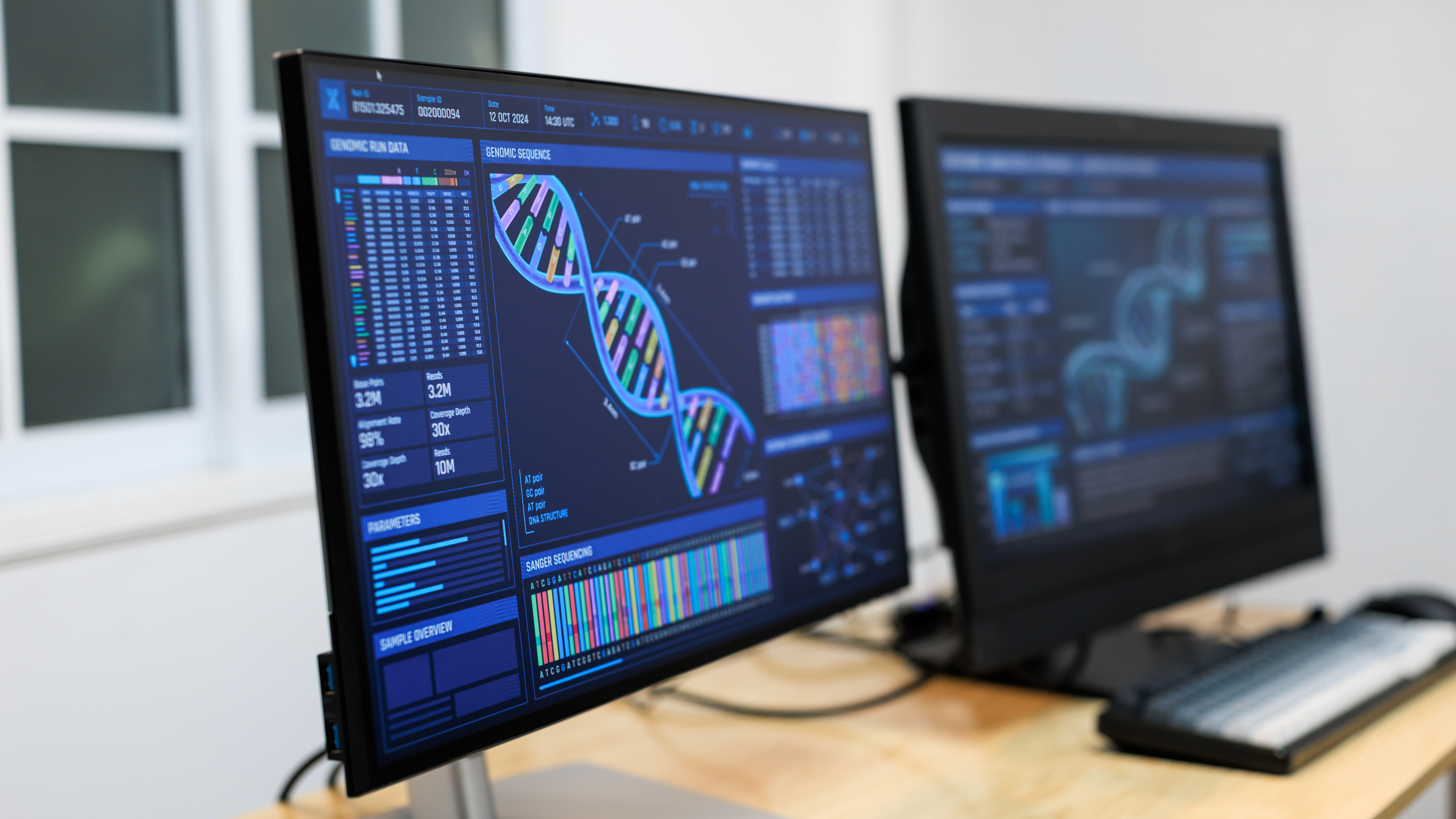
GENOMIC SEQUENCE
ATGCGTA
TACGCAT
DNA • SEQUENCING • ANALYSIS
Genomics Transcriptomics Proteomics Systems Biology Artificial Intelligence
02 / Scientific Disciplines

Explore the Bioinformatics Research Ecosystem.

Bioinformatics integrates biological knowledge, computer science, statistics, and mathematical modeling to investigate complex biological systems. Explore the interconnected disciplines shaping modern life science research.

BIOLOGICAL DATA NETWORK Connecting molecular information and computation
BIO DATA GENOMICS RNA-SEQ PROTEOMICS AI / ML PATHWAYS DATABASES
One interconnected research landscape Molecular biology · Data science · Discovery
FEATURED RESEARCH AREA / 01

Genomics & Transcriptomics

Genomics investigates genome organization, sequence variation, and the biological information encoded in DNA. Transcriptomics examines RNA expression patterns to understand how genes are regulated across cells, tissues, and experimental conditions.

Modern bioinformatics workflows combine sequencing, computational analysis, statistical methods, and biological interpretation to transform large-scale DNA and RNA datasets into research findings.

  • Whole-genome and exome sequencing analysis
  • RNA sequencing and differential gene expression
  • Genetic variant identification and annotation
  • Functional genomics and biological interpretation
Explore Genomics

Explore beyond individual disciplines. Understand how genomics, proteins, biological networks, and computational methods work together to advance scientific discovery.

Browse Scientific Resources ↗

03 / SCIENTIFIC WORKFLOWS

From Biological Data to Scientific Discovery.

Bioinformatics transforms experimental datasets into interpretable biological results through computational workflows. Explore the fundamental stages of next-generation sequencing analysis, from raw sequence reads to downstream interpretation.

SEQUENCING DATA / NUCLEOTIDE READ DNA SEQUENCE REPRESENTATION
SEQUENCE INPUT COMPUTATIONAL PROCESSING ↓
STAGE 01 ↗

Data Generation & Acquisition

Obtain sequencing reads and experiment metadata. FASTQ is a common format for raw short-read sequence data and quality scores.

STAGE 02 ↗

Quality Control & Preprocessing

Examine read quality, identify technical artifacts, and perform appropriate adapter removal or filtering.

STAGE 03 ↗

Read Mapping & Processing

Align reads to a reference genome or transcriptome when appropriate, or use reference-free methods for suitable applications.

STAGE 04 ↘

Computational Analysis

Apply analytical methods chosen for the research question, sequencing strategy, and experimental design.

ANALYSIS PATH A / DNA

Genomic Variant Analysis

Identify, filter, annotate, and interpret sequence variants such as SNVs and indels in relevant DNA sequencing studies.

ANALYSIS PATH B / RNA

Gene Expression Analysis

Quantify transcript or gene abundance, assess differential expression, and investigate functional patterns in RNA-seq studies.

Biological Interpretation & Research Insight

Integrate statistically supported findings with functional annotation, pathways, biological context, and experimental validation where appropriate.

These stages provide a conceptual overview; individual workflows differ across sequencing platforms, assay types, and research objectives.

Explore the NGS Analysis Guide ↗

04 / SCIENTIFIC KNOWLEDGE LIBRARY

Explore Knowledge.
Advance Discovery.

Discover scientific explanations, computational methodologies, biological databases, and research-focused resources covering genomics, proteomics, sequencing analysis, and computational biology.

EXPLORE BY SCIENTIFIC TOPIC

BioInfoData connects fundamental biological concepts with computational methods and practical approaches to scientific data interpretation.

Explore Scientific Resources ↗

05 / BIOINFORMATICS RESOURCE EXPLORER

Explore the Tools Behind Discovery.

Scientific databases and computational resources are essential to modern biological research. Explore established platforms supporting sequence analysis, genome exploration, protein annotation, molecular structure research, and functional genomics.

CURATED SCIENTIFIC RESOURCE DIRECTORY Explore external research databases ↗

06 / RESEARCH METHODS EXPLORER

Start With a Question.
Find the Right Analysis.

Different biological questions require different experimental designs and computational approaches. Explore common research objectives and the bioinformatics methods used to investigate them.

WHAT DO YOU WANT TO INVESTIGATE? FOUR COMMON RESEARCH OBJECTIVES ↓
RESEARCH QUESTION / 01
GENOMICS

Which Genetic Variants Are Present?

Investigate sequence differences relative to a reference, such as single-nucleotide variants and small insertions or deletions. The appropriate methods depend on the organism, assay, and variant types of interest.

Relevant approaches Whole-genome or exome sequencing, read alignment, variant calling, filtering, and annotation.
RESEARCH QUESTION / 02
TRANSCRIPTOMICS

How Does Gene Expression Change?

Compare RNA abundance across biological conditions, sample groups, or time points. Reliable inference depends on experimental replication, normalization, statistical modeling, and appropriate controls.

Relevant approaches RNA-seq, transcript quantification, differential expression analysis, and functional enrichment.
RESEARCH QUESTION / 03
STRUCTURAL BIOLOGY

What Is the Structure of a Protein?

Explore three-dimensional protein organization and investigate possible relationships between structure and biological function. Computational predictions require critical assessment and may need experimental validation.

Relevant approaches Structure databases, comparative modeling, structure prediction, visualization, and structural analysis.
RESEARCH QUESTION / 04
SYSTEMS BIOLOGY

Which Biological Pathways Are Involved?

Examine biological processes associated with an observed molecular pattern. Pathway and network analyses can help generate hypotheses about coordinated biological functions and mechanisms.

Relevant approaches Gene-set enrichment, pathway analysis, molecular interaction networks, and multi-omics integration.

FREQUENTLY ASKED QUESTIONS

Understanding Bioinformatics Methods.

Concise answers to common questions about computational analysis in life science research.

What is a bioinformatics workflow?

A bioinformatics workflow is an organized sequence of computational steps used to process, analyze, and interpret biological data. It may combine software tools, databases, statistical methods, and quality-control procedures.

What is the difference between genomics and transcriptomics?

Genomics investigates genomes, including their sequences, organization, and variation. Transcriptomics studies RNA molecules and their abundance or expression patterns under specific biological conditions.

What does NGS data analysis involve?

Depending on the application, NGS data analysis may involve assessing sequence quality, preprocessing reads, alignment or assembly, quantification or variant detection, statistical analysis, and biological interpretation.

Why are biological databases important?

Biological databases organize research information such as sequences, genome annotations, protein functions, structures, and experimental datasets. They support data retrieval, comparison, annotation, and reproducibility.

Can artificial intelligence replace conventional bioinformatics analysis?

AI and machine learning can support tasks such as pattern recognition, prediction, and data integration. They complement conventional methods but do not remove the need for data quality assessment, experimental context, model validation, and biological interpretation.

Continue Exploring Bioinformatics.

Learn how sequencing technologies and computational approaches convert experimental data into scientific findings.

Read the NGS Guide ↗

07 / THE BIOINFODATA MISSION

Connecting Biology, Data & Discovery.

Biological research increasingly relies on computational methods to investigate the complexity of genes, proteins, molecular interactions, and biological systems.

BioInfoData brings together scientific knowledge and bioinformatics resources to support the exploration, understanding, and interpretation of biological data.

Our mission is to make computational biology more accessible through structured explanations, research-oriented guides, and connections between fundamental scientific concepts and their practical applications.

Explore BioInfoData
BIOLOGY + DATA GENOMICS PROTEOMICS COMPUTATION SYSTEMS BIOLOGY
SCIENTIFIC INFORMATION NETWORK DATA ↗ KNOWLEDGE
01 / CLARITY

Explain Complex Science

Present bioinformatics concepts and computational methods using clear scientific explanations while preserving important technical distinctions.

02 / CONNECTION

Connect Research Disciplines

Explore relationships between genomics, transcriptomics, proteomics, systems biology, and computational research methodologies.

03 / APPLICATION

Support Practical Understanding

Connect biological research questions with relevant analysis concepts, scientific resources, and methods for interpreting experimental data.

SCIENTIFIC FOCUS AREAS
Genomics Transcriptomics Proteomics Systems Biology Computational Biology

08 / CONTINUE YOUR DISCOVERY

The Next Discovery Starts With Better Questions.

Whether you are exploring genomic variation, interpreting RNA sequencing results, investigating protein function, or studying molecular pathways, BioInfoData provides scientific knowledge and research resources to help you navigate biological data analysis.

BioInfoData — Exploring the connections between biology, computation, and data science.

SCIENCE × DATA × KNOWLEDGE